
Dostęp do tego artykułu jest płatny.
Zapraszamy do zakupu!
Po dokonaniu zakupu artykuł w postaci pliku PDF prześlemy bezpośrednio pod twój adres e-mail.
Streszczenie
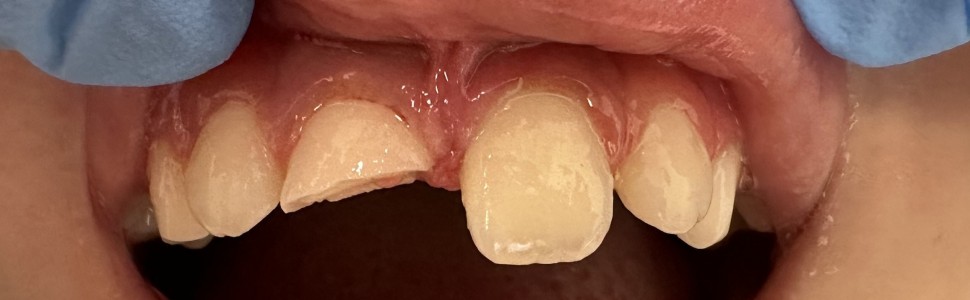
W pracy opisano przypadek leczenia kanałowego zęba siecznego przyśrodkowego szczęki z niezakończonym rozwojem korzenia. Konieczność przeprowadzenia leczenia wynikała z powikłanego złamania korony zęba w następstwie urazu. W związku z dużą utratą tkanek własnych oraz perspektywą przyszłej odbudowy protetycznej podjęto decyzję o leczeniu metodą apeksyfikacji z użyciem past na bazie wodorotlenku wapnia.
Piśmiennictwo:
- 1 Barańska – Gachowska i wsp. „Endodoncja wieku rozwojowego i dojrzałego” wyd. III, tom 1-2, Wydawnictwo Czelej, Lublin 2021
- Olczak-Kowalczyk, J. Szczepańska, U. Kaczmarek 2017 ,,Współczesna stomatologia wieku rozwojowego” wyd. I, Otwock, Med Tour Press International.].
- Andreasen JO, Bakland LK, Flores MT: Pourazowe uszkodzenia zębó Wydawnictwo Elsevier Urban & Partner, Wrocław 2020.
- Kallel I, Douki N, Amaidi S, Amor FB: The incidence of complications of dental trauma and associated factors: A retrospective study. Int J Dent 2020; 11: 2020: 2968174.
- Diogenes A, Ruparel NB, Shiloah Y, Hargreaves KM. Regenerative endodontics: a way forward. J Am Dent Assoc. 2016;147(5):372–80.
- Cehreli ZC, Sara S, Aksoy B. Revascularization of immature permanent incisors after severe extrusive luxation injury. J Can Dent Assoc. 2012;78:c4.
- Saoud TM, Ricucci D, Lin LM, Gibbs JL, Huang GTJ. Regeneration and repair in endodontics—a special issue. Dent J (Basel). 2016;4(3):20.
- Bose R, Nummikoski P, Hargreaves K. A retrospective evaluation of radiographic outcomes in immature teeth with necrotic root canal systems treated with regenerative endodontic procedures. J Endod. 2009;35(10):1343–9
- Shimizu E, Ricucci D, Albert J, Alobaid AS, Gibbs JL, Huang GTJ, et al. Clinical, radiographic, and histological observations of a human immature permanent tooth with chronic apical abscess after revitalization therapy. J Endod. 2013;39(8):1078–83.
- American Association of Endodontists. AAE Clinical Considerations for a Regenerative Procedure. 2018.
- European Society of Endodontology. Position statement: Revitalisation procedures. Int Endod J. 2016;49(8):717–23.
- Imtiaz T, Adimulapu HS, Pandiyan I, Bhandari S. Dentist perspective on knowledge and practice toward Ellis class 3 tooth fracture: A survey. J Adv Pharm Technol Res. 2022;13(2):129–33.
- Parirokh M, Torabinejad M. Mineral trioxide aggregate: a comprehensive literature review—Part I: chemical, physical, and antibacterial properties. J Endod. 2010;36(1):16–27.
- Koch K, Brave D. Bioceramics: The new paradigm in endodontic obturation. Dent Today. 2012;31(1):110, 112, 114–5.
- Węgrzyn R, Korczyńska-Smytkiewicz M, Sobiech P. Utrata żywotności miazgi w zębach siecznych stałych po urazach na podstawie przypadków klinicznych. Nowa Stomatologia. 2022;27(1):29–36.
Główne funkcje układu stomatognatycznego – Jeffrey P. Okeson (fragment książki)
Streszczenie:
Układ stomatognatyczny spełnia trzy podstawowe funkcje: (1) żucie, (2) połykanie i (3) mowa. Istnieją również dodatkowe role układu, które wspierają oddychanie i wyrażanie emocji. Wszystkie czynnościowe ruchy są wysoko skoordynowanymi, złożonymi zjawiskami neuromięśniowymi. Impulsacja czuciowa ze struktur układu stomatognatycznego (tzn. zębów, ozębnej, warg, języka, policzków, podniebienia) jest otrzymywana przez centralny generator wzorca i integrowana z istniejącymi modelami odruchowymi oraz wyuczonymi engramami mięśniowymi, by spełnić pożądaną czynność. Zwarcie zębów odgrywa zasadniczą rolę w funkcjonowaniu układu stomatognatycznego, dlatego też zrozumienie dynamiki podstawowych aktywności funkcjonalnych jest niezwykle istotne.
Piśmiennictwo:
1. Okeson JP. Bell’s Oral and Facial Pain, ed 7, Chicago, IL, 2014, Quintessence Publishing Co, Inc.
2. Okeson JP. Bell’s Orofacial Pains, ed 6, Chicago, IL, 2005, Quintessence Publishing Co, Inc.
3. Guyton AC. Textbook of Medical Physiology, ed 8, Philadelphia, PA, 1991, W.B. Saunders Co.
4. Anderson DM. Dorlands Illustrated Medical Dictionary, ed 28, Philadelphia, PA,1988, W.B. Saunders Co.
5. Hollingsworth HL. Chewing as a technique of relaxation, Science 90:385–387, 1939.
6. Jenkins GN. Th e Physiology and Biochemistry of the Mouth, ed 4, Oxford, 1974, Blackwell Scientific Publications.
7. Konno M, Takeda T, Kawakami Y i wsp. Relationships between gum-chewing and stress, Adv Exp Med Biol 876:343-349, 2016.
8. Petrowski K, Wintermann GB, Joraschky P, Passler S. Chewing after stress: psychosocial stress influences chewing frequency, chewing efficacy, and appetite, Psychoneuroendocrinology 48:64-76, 2014.
9. Nishigawa K, Nakano M, Bando E, Clark GT. Effect of altered occlusal guidance on lateral border movement of the mandible, J Prosthet Dent 68:965–969, 1992.
10. Lundeen HC, Gibbs CH. Advances in Occlussion, Boston, MA, 1982, John Wright PSC, Inc.
11. Schweitzer JM. Masticatory function in man, J Prosthet Dent 11:625–647, 1961.
12. Gibbs CH, Messerman T, Reswick JB, Derda HJ. Functional movements of the mandible, J Prosthet Dent 26:604–620, 1971.
13. Horio T, Kawamura Y. Eff ects of texture of food on chewing patterns in the human subject, J Oral Rehabil 16:177–183, 1989.
14. Pond LH, Barghi N, Barnwell GM. Occlusion and chewing side preference, J Prosthet Dent 55(4):498–500, 1986.
15. Beyron HL: Occlusal changes in the adult dentition, J Am Dent Assoc 48:674–686, 1954.
16. Beyron HL: Occlusal relations and mastication in Australian Aborigines, Acta Odontol Scand 22:597–678.
17. Rovira-Lastra B, Flores-Orozco EI, Ayuso-Montero R, Peraire M, Martinez-Gomis J. Peripheral, functional and postural asymmetries related to the preferred chewing side in adults with natural dentition, J Oral Rehabil 43(4):279-285, 2016.
18. Throckmorton GS, Groshan GJ, Boyd SB. Muscle activity patterns and control of temporomandibular joint loads, J Prosthet Dent 63(6):685–695, 1990.
19. Christensen LV, Rassouli NM. Experimental occlusal interferences. Part IV. Mandibular rotations induced by a pliable interference, J Oral Rehabil 22:835–844, 1995.
20. Rassouli NM, Christensen LV. Experimental occlusal interferences. Part III. Mandibular rotations induced by a rigid interference, J Oral Rehabil 22(10):781–789, 1995.
21. Jankelson B, Hoffman GM, Hendron AJ. Physiology of the stomatognathic system, J Am Dent Assoc 46:375–386, 1953.
22. Anderson DJ, Picton DCA. Tooth contact during chewing, J Am Dent Assoc 36:21–26, 1957.
23. Ahlgren J. Mechanism of mastication, Acta Odontol Scand 24:44–45, 1966.
24. Adams SH, Zander HA. Functional tooth contacts in lateral and centric occlusion, J Am Dent Assoc 69:465–473, 1964.
25. Glickman I, Pameijer JH, Roeber FW i wsp. Functional occlusion as revealed by miniaturized radio transmitters, Dent Clin North Am 13:667–679, 1969.
26. Suit SR, Gibbs CH, Benz ST. Study of gliding tooth contacts during mastication, J Periodontol 47:331–334, 1975.
27. Mongini F, Tempia-Valenta G. A graphic and statistical analysis of the chewing movements in function and dysfunction, Cranio 2(2):125–134, 1984.
28. Kerstein RB, Radke J. Average chewing pattern improvements following disclusion time reduction, Cranio 35(3):135-151, 2017.
29. Brekhus PJ, Armstrong WD, Simon WJ. Stimulation of the muscles of mastication, J Dent Res 20:87–92, 1941.
30. Gibbs CH, Mahan PE, Mauderli A, Lundeen HC, Walsh EK. Limit of human bite strength, J Prosthet Dent 56(2):226–229, 1986.
31. Howell AH, Manly RS: An electronic strain gauge for measuring oral forces, J Dent Res 27:705–712, 1948.
32. Garner LD, Kotwal NS. Correlation study of incisive biting forces with age, sex, and anterior occlusion, J Dent Res 52:698–702, 1973.
33. Worner HK, Anderson MN. Biting force measurements in children, Aust Dent J 48:1–5, 1944.
34. Worner HK. Gnathodynamics: the measurement of biting forces with a new design of gnathodynamometer, Aust Dent J 43:381–386, 1939.
35. Kiliardis S, Tzakis MG, Carlsson GE. Effects of fatigue and chewing training on maximal bite force and endurance, Am J Orthod Dentofac Orthop 107:372–378, 1995.
36. Waugh LM. Dental obsevation among eskimos, J Dent Res 16:355– 356, 1937.
37. Gibbs CH, Mahan PE, Lundeen HC, Brehan K. Occlusal forces during chewing: influence on biting strength and food consistency, J Prosthet Dent 46:561–567, 1981.
38. Anderson DJ. Measurement of stress in mastication. II, J Dent Res 35:671–674, 1956.
39. Goldreich H, Gazit E, Lieberman MA, Rugh JD. The effect of pain from orthodontic arch wire adjustment on masseter muscle electromyographic activity, Am J Orthod Dentofac Orthop 106(4):365–370, 1994.
40. Bakke M, Michler L. Temporalis and masseter muscle activity in patients with anterior open bite and craniomandibular disorders, Scand J Dent Res 99(3):219–228, 1991.
41. Howell AH, Brudevold F. Vertical forces used during chewing of food, J Dent Res 29:133–136, 1950.
42. Brudevold F. A basic study of the chewing forces of a denture wearer, J Am Dent Assoc 43:45–51, 1951.
43. Lundgren D, Laurell L. Occlusal force pattern during chewing and biting in dentitions restored with fixed bridges of cross-arch extension, J Oral Rehabil 13:57–71, 1986.
44. Michael CG, Javid NS, Colaizzi FA, Gibbs CH. Biting strength and chewing forces in complete denture wearers, J Prosthet Dent 63:549–553, 1990.
45. Cleall JF. A study of form and function, Am J Orthod 51:566–594, 1965.
46. Gillings BRD, Kohl JT, Zander HA. Contact patterns using miniature radio transmitters, J Dent Res 42:177–180, 1963.
47. Graf H, Zander HA. Tooth contact patterns in mastication, J Prosthet Dent 13:1055–1066, 1963.
48. Butler JH, Zander HA. Evaluation of two occlusal concepts, Periodont Acad Rev 2:5–19, 1968.
49. Arstad T. Retrusion facets (book review), J Am Dent Assoc 52:519, 1956.
50. Ramfjord SP. Dysfunctional temporomandibular joint and muscle pain, J Prosthet Dent 11:353–362, 1961.
51. Flanagan JBea. The 24-hour pattern of swallowing in man, J Dent Res 42(abstr# 165):1072, 1963.
52. Schneyer LH, Pigman W, Hanahan L, Gilmore RW. Rate of flow of human parotid, sublingual and submaxillary secretions during sleep, J Dent Res 35:109–114, 1956.