
Dostęp do tego artykułu jest płatny.
Zapraszamy do zakupu!
Po dokonaniu zakupu artykuł w postaci pliku PDF prześlemy bezpośrednio pod twój adres e-mail.
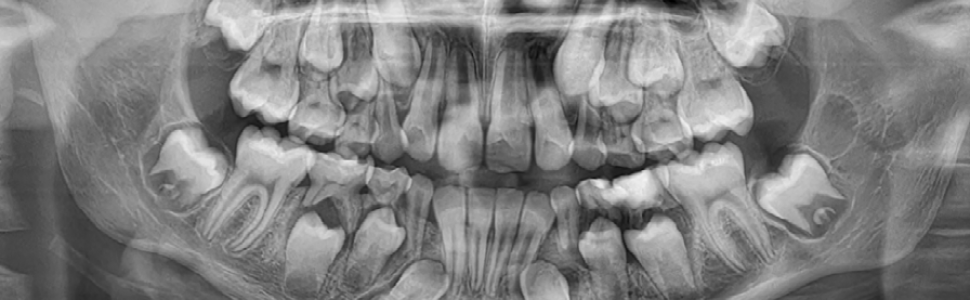
Złamanie trzonu żuchwy u dziecka w wieku rozwojowym – opis przypadku
Paweł Tsynkel, Kinga Popielarczyk, Patrycja Bartkowska, Beata Jeziorska
Mandibular body fracture in a developing child – a case report
Streszczenie
Złamania żuchwy u dzieci należą do stosunkowo rzadkich urazów twarzoczaszki, jednak ich wystąpienia wymagają szczególnej uwagi ze względu na obecność aktywnych centrów wzrostu i zawiązków zębów stałych. W pracy przedstawiono przypadek 10-letniego pacjenta, u którego doszło do obustronnego złamania trzonu żuchwy. Zastosowano leczenie zachowawcze z wykorzystaniem szynowania ortodontycznego. Przebieg leczenia i kontrola radiologiczna po 6 miesiącach potwierdziły skuteczność postępowania. Podkreślono znaczenie szybkiej diagnostyki, zachowawczego podejścia oraz regularnej kontroli u dzieci w okresie intensywnego rozwoju twarzoczaszki.
Hasła indeksowe: złamanie żuchwy, szynowanie ortodontyczne, uraz twarzoczaszki u dziecka
Abstract
Mandibular fractures in children are relatively rare but require special care due to the presence of active growth centers and permanent tooth buds. This paper presents a case of a 10-year-old patient who sustained bilateral mandibular body fractures. Conservative treatment with orthodontic splinting was applied. Follow-up and radiological assessment after 6 months confirmed successful healing. The case highlights the importance of timely diagnosis, minimally invasive management, and regular follow-up in pediatric craniofacial trauma.
Key words: mandibular fracture, orthodontic splinting, pediatric craniofacial trauma
Piśmiennictwo:
- Zieliński R, Piotrowska V, Zakrzewska A. Urazy twarzoczaszki u dzieci – problem nie tylko medyczny. Otorynolaryngologia. 2011; 10(1): 30-35.
- Goth S, Sawatari Y, Peleg M. Management of pediatric mandible fractures. J Craniofac Surg. 2012; 23(1): 47-56.
- Amaratunga NA. Mandibular fractures in children – a study of clinical aspects, treatment needs, and complications. J Oral Maxillofac Surg. 1988; 46(8): 637-640.
- Aizenbud D, Hazan-Molina H, Emodi O i wsp. The management of mandibular body fractures in young children. Dent Traumatol. 2009; 25(6): 565-570.
- Panesar K, Susarla SM. Mandibular fractures: diagnosis and management. Semin Plast Surg. 2021; 35(4): 238-249.
- Moss ML, Rankow RM. The role of the functional matrix in mandibular growth. Angle Orthod. 1968; 38(2): 95-103.
- Ferreira PC, Amarante JM, Silva PN i wsp. Retrospective study of 1251 maxillofacial fractures in children and adolescents. Plast Reconstr Surg. 2005; 115(6): 1500-1508.
- Nixon F, Lowey MN. Failed eruption of the permanent canine following open reduction of a mandibular fracture in a child. Br Dent J. 1990; 168(5): 204-205.
- Alcalá-Galiano A, Arribas-García IJ, Martín-Pérez MA i wsp. Pediatric facial fractures: children are not just small adults. Radiographics. 2008; 28(2): 441-461.
- Sharma S, Vashistha A, Chugh A i wsp. Pediatric mandibular fractures: a review. Int J Clin Pediatr Dent. 2009; 2(2): 1-5.