
Dostęp do tego artykułu jest płatny.
Zapraszamy do zakupu!
Po dokonaniu zakupu artykuł w postaci pliku PDF prześlemy bezpośrednio pod twój adres e-mail.
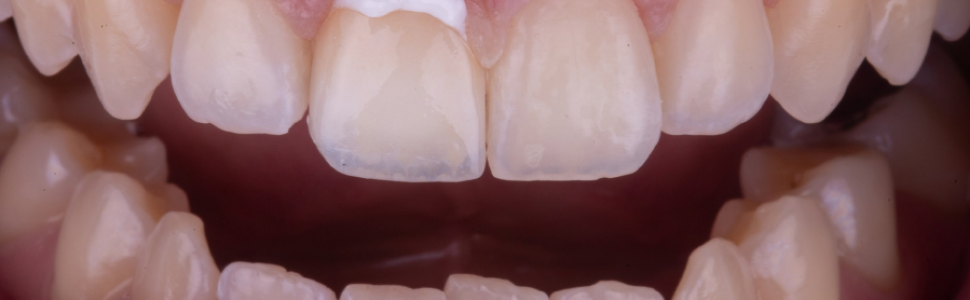
Bezpośrednia licówka kompozytowa w odcinku przednim wykonana z użyciem uniwersalnego kompozytu typu bulk-fill z uproszczonym systemem odcieni – opis przypadku klinicznego
Jürgen Manhart
Streszczenie:
Dziś najwyższe wymagania estetyczne można spełnić dzięki rekonstrukcjom kompozytowym wykonywanym bezpośrednio. Wypełnienia z kompozytów można wykonać w trakcie jednej wizyty, bez potrzeby pobierania wycisku i osadzania uzupełnienia tymczasowego. W porównaniu z rekonstrukcjami pośrednimi (licówki, korony), bezpośrednie odbudowy kompozytowe przyczyniają się do ochrony tkanek twardych i miękkich.
Hasła indeksowe:
kompozyt, rekonstrukcje bezpośrednie, zęby przednie, technika adhezyjna
Summary:
Today, the highest aesthetic demands can be satisfied with direct composite restorations. In addition to protecting the hard and soft tissues compared to indirect procedures (veneers, crowns), the restoration can be created in one appointment without an impression or temporary restoration at reduced costs.
Key words:
composite, direct restorations, anterior teeth, adhesive technique
Piśmiennictwo:
1. Ferracane JL. Resin composite – state of the art. Dent Mater. 2011; 27(1): 29-38.
2. Pitel ML. Low-shrink composite resins: a review of their history, strategies for managing shrinkage, and clinical significance. Compend Contin Educ Dent. 2013; 34(8): 578-590.
3. Fahl N Jr, Paravina RD. Direct composite restorations – the ugly duckling classic. J Dent. 2013; 41 Suppl 5: e1-e2.
4. Fahl N Jr, Denehy GE, Jackson RD. Protocol for predictable restoration of anterior teeth with composite resins. Pract Periodontics Aesthet Dent. 1995; 7(8): 13-21.
5. Fahl N Jr. Predictable aesthetic reconstruction of fractured anterior teeth with composite resins: a case report. Pract Periodontics Aesthet Dent. 1996; 8(1): 17-31.
6. Vanini L. Light and color in anterior composite restorations. Pract Periodontics Aesthet Dent. 1996; 8(7): 673-682.
7. Vanini L, Mangani FM. Determination and communication of color using the five color dimensions of teeth. Pract Proced Aesthet Dent. 2001; 13(1): 19-26.
8. Dietschi D. Free-hand bonding in the esthetic treatment of anterior teeth: creating the illusion. J Esthet Dent. 1997; 9(4): 156-164.
9. Dietschi D. Layering concepts in anterior composite restorations. J Adhes Dent. 2001; 3(1): 71-80.
10. Dietschi D. Free-hand bonding: the ultimate treatment modality to enhance smiles in young patients. Australas Dent Pract. 2012; 1: 150-154.
11. Baratieri LN, Araujo E, Monteiro S Jr. Color in natural teeth and direct resin composite restorations: essential aspects. Eur J Esthet Dent. 2007; 2(2): 172-186.
12. Allgeier S, Hahn B, Krastl G. Direkte Frontzahnrestaurationen aus Komposit. wissen kompakt. 2019; 13(3): 103-114.
13. Wolff D. Ästhetische Rehabilitation mit direkten Kompositrestaurationen im Frontzahnbereich. wissen kompakt. 2013; 7(4): 29-40.
14. Frese C, et al. Recontouring teeth and closing diastemas with direct composite buildups: a 5-year follow-up. J Dent. 2013; 41(11): 979-985.
15. LeSage BP. Aesthetic anterior composite restorations: a guide to direct placement. Dent Clin North Am. 2007; 51(2): 359-378.
16. Mackenzie L, et al. Direct anterior composites: a practical guide. Dent Update. 2013; 40(4): 297-308.
17. Okuda WH. Minimally invasive dentistry and its impact on esthetic restorative dentistry. Gen Dent. 2013; 61(5): 24-26.
18. Brackett MG, et al. The effect of light curing source on the residual yellowing of resin composites. Oper Dent. 2007; 32(5): 443-450.
19. Cook WD. Photopolymerization kinetics of dimethacrylates using the camphorquinone/amine initiator system. Polymer. 1992; 33(3): 600-609.
20. Ardu S, et al. Influence of water sorption on resin composite color and color variation amongst various composite brands with identical shade code: an in vitro evaluation. J Dent. 2011; 39 Suppl 1: e37-e44.
21. Ferracane JL, et al. Academy of Dental Materials guidance – Resin composites: Part II – Technique sensitivity (handling, polymerization, dimensional changes). Dent Mater. 2017; 33(11): 1171-1191.
22. Kamoun EA, et al. Carboxylated camphorquinone as visible-light photoinitiator for biomedical application: synthesis, characterization, and application. Arab J Chem. 2016; 9(5): 745-754.
23. Sakaguchi RL, Ferracane J, Powers JM. Craig’s Restorative Dental Materials. 14th ed. St. Louis: Elsevier; 2019.
24. de Goes MF, Shinohara MS, Freitas MS. Performance of a new one-step multi-mode adhesive on etched vs non-etched enamel on bond strength and interfacial morphology. J Adhes Dent. 2014; 16(3): 243-250.
25. Hanabusa M, et al. Bonding effectiveness of a new ‘multi-mode’ adhesive to enamel and dentine. J Dent. 2012; 40(6): 475-484.
26. McLean DE, et al. Enamel bond strength of new universal adhesive bonding agents. Oper Dent. 2015; 40(4): 410-417.
27. Takamizawa T, et al. Influence of different etching modes on bond strength and fatigue strength to dentin using universal adhesive systems. Dent Mater. 2016; 32(2): e9-e21.
28. Wagner A, et al. Bonding performance of universal adhesives in different etching modes. J Dent. 2014; 42(7): 800-807.
29. Lenzi TL, et al. Bonding performance of a multimode adhesive to artificially-induced caries-affected primary dentin. J Adhes Dent. 2015; 17(2): 125-131.
30. Loguercio AD, et al. A new universal simplified adhesive: 36-month randomized double-blind clinical trial. J Dent. 2015; 43(9): 1083-1092.
31. Munoz MA, et al. In vitro longevity of bonding properties of universal adhesives to dentin. Oper Dent. 2015; 40(3): 282-292.
32. Willhite C. Composite Bonding: The “Structure” Course. Handout. New England Academy of Cosmetic Dentistry; 2014.
33. Fahl N Jr. A polychromatic composite layering approach for solving a complex Class IV/direct veneer-diastema combination: part I. Pract Proced Aesthet Dent. 2006; 18(10): 641-645.